

Added-Value Processing
Blending, screening, sieving, custom specs — Egypt Globe processes raw commodities to your tender specification before loading.
Added-value processing — from raw feedstock to the buyer's tender specification, verified lot by lot
Bulk commodities rarely match a tender specification out of the quarry, plant or saltwork. Egypt Globe Group operates an in-house added-value processing layer — blending, screening, washing and kiln-drying — that closes the gap between raw feedstock and the buyer's technical specification, so cargo lands on the vessel ready for the consignee's production line rather than as raw material that needs reprocessing on arrival.
Processing is also where lot-to-lot inconsistency is created in much of the regional market: blends made by eye, screens that are not recalibrated, dryers run to time rather than to moisture. EGG's processing is run by the Quality Assurance division that has been at the nucleus of the group since incorporation. Each step is specified, trialled and then verified on the processed lot by the port laboratory before the Certificate of Analysis is issued — the CoA reflects the actual processed product, not the feedstock.
Service scope
| Scope | What EGG does | Evidence issued | Responsible team |
|---|---|---|---|
| Blending | Combines feedstocks of known assay to hit the contract specification — salt NaCl grades, fertilizer NPK ratios, aggregate gradations, blended cements to EN 197-1 / ASTM C595 | Blend-trial report, blend sheet on the lot genealogy | QA division + processing plant |
| Screening & sieving | Particle-size control to the millimetre on vibrating screens with calibrated decks | Sieve analysis per EN 933-1 / ASTM E11 | Processing plant + port lab |
| Washing | Single- and double-pass freshwater washing of sea salt to raise NaCl and remove insolubles | Pre- and post-wash assay | Saltworks laboratory |
| Kiln-drying | Moisture reduction for EN 16811-1 Type 1, BS 3247 and GOST kiln-dried grades; anti-caking (E535) dosing on request | Moisture and E535 result on the CoA | Processing plant + port lab |
| Sun-drying | Yard drying for grain, oilseeds and feedstuffs | Moisture result | Agro division |
| Custom-spec engineering | Translates the buyer's tender into a production specification, sources feedstocks, runs trials and confirms achievability before quoting | Feasibility confirmation in the quotation | QA division |
Service-level parameters
Salt processing tiers (company specification)
| Tier | Source | NaCl | Processing step |
|---|---|---|---|
| Rock salt | Siwa Oasis + Qattara Depression | guaranteed ≥ 97.00 % | Crushing and screening; kiln-drying on request |
| Raw sea salt | North Sinai (El-Arish / Bardawil) + Red Sea (Ain Sokhna) | 94–97 % | Harvest, stacking, screening |
| Washed sea salt | North Sinai + Red Sea | 97.5–98 % | Single-pass freshwater wash |
| Double-washed sea salt | North Sinai + Red Sea | ≥ 99 % | Two-pass wash and recrystallisation |
Blend and particle-size capability
- Salt blends
- Multiple NaCl feedstocks blended to the exact contract figure (e.g. a 97.5 % NaCl de-icing blend from 96 % raw and 99 % washed inputs); EN 16811-1 Type 1 with anti-caking and Type 2 natural-moisture variants
- De-icing fractions
- 0–4 / 0–6.3 / 0–8 / 2–8 / 10–40 mm
- Industrial salt fractions
- 0.2–0.8 / 0.5–2.0 / 1–3 mm
- Fertilizer NPK
- Bulk-blended to the buyer's N-P-K ratio before bagging (10-30-10, 15-15-15, 20-20-20 and others)
- Aggregates
- 6 / 10 / 14 / 20 / 25 mm chips; multi-sieve blends to the destination standard
- Limestone / dolomite / silica sand
- Foundry, glass and cement-grade fractions
- Cement / clinker
- Lump separation, oversize rejection; slag, fly-ash and pozzolanic blends to EN 197-1 / ASTM C595
- Kiln-drying target
- 2.0 %, 1.0 % or 0.5 % moisture, to the tender, for EN 16811-1 Type 1 de-icing salt
- Blend trial
- Bench blend tested by the port laboratory before the quotation is confirmed
QA verification chain
-
1
Extraction / source
Each feedstock assayed before it enters a blend or wash
EvidenceFeedstock lab report
Source laboratory · every feedstock lot
-
2
Processing
Screen decks, wash water and dryer outlet checked against the process specification; bench blend trial before scale-up
EvidenceProcess record, blend-trial report
QA division · every processed lot
-
3
Port laboratory
Composite sample of the processed lot; full analysis; CoA / MTC issued before B/L; out-of-spec lot rejected
EvidencePer-lot CoA with lot genealogy
Port QC team · every lot
-
4
Independent inspection
Sampling and witness test of the processed lot at the port
EvidenceCertificate of Inspection
TÜV Austria / SGS / Intertek / Bureau Veritas · per shipment when contracted
-
5
Destination acceptance
Buyer's arrival test reconciled to the CoA; the CoA values match because they describe the processed product
EvidenceArrival report
Buyer lab + EGG QA · per shipment
Applications & markets
Processing is specified per end use: kiln-dried Type 1 and natural-moisture Type 2 fractions for road de-icing under EN 16811-1; low-insolubles washed grades for chlor-alkali and water treatment; coarse screened rock salt for leather tanning and oil and gas drilling; blended fertilizers per the NPK market guide; blended cements per EN 197-1.
Standards & documentation
- Gradation reported per EN 933-1 or ASTM E11; chemistry per the standard named in the contract — EN 16811-1, BS 3247, ASTM D632, GOST 13830, EN 197-1, ASTM C150.
- Every blend / sieve / wash / dry step is captured in the lot genealogy on the per-shipment CoA; document set per trade documentation; third-party verification per inspection & quality control; group systems per quality & compliance.
Combine with packing + inspection
Added-value processing pairs naturally with Packing & Containerisation (post-processing bagging in the buyer's preferred format) and Pre-Shipment Inspection (third-party verification at the dock).
Request a quote
Attach the tender or technical specification to the RFQ; the QA division confirms achievability, the processing route and the resulting specification in the offer. Request a quote.
Contents· 7 sections
Sourcing this?
Send grade, tonnage and destination and the export desk replies with a priced offer.
Request a quoteReady for a quote?
FOB / CIF / CFR pricing from 8 Egyptian ports — turnaround once stock, laycan and freight are confirmed.
More in Services
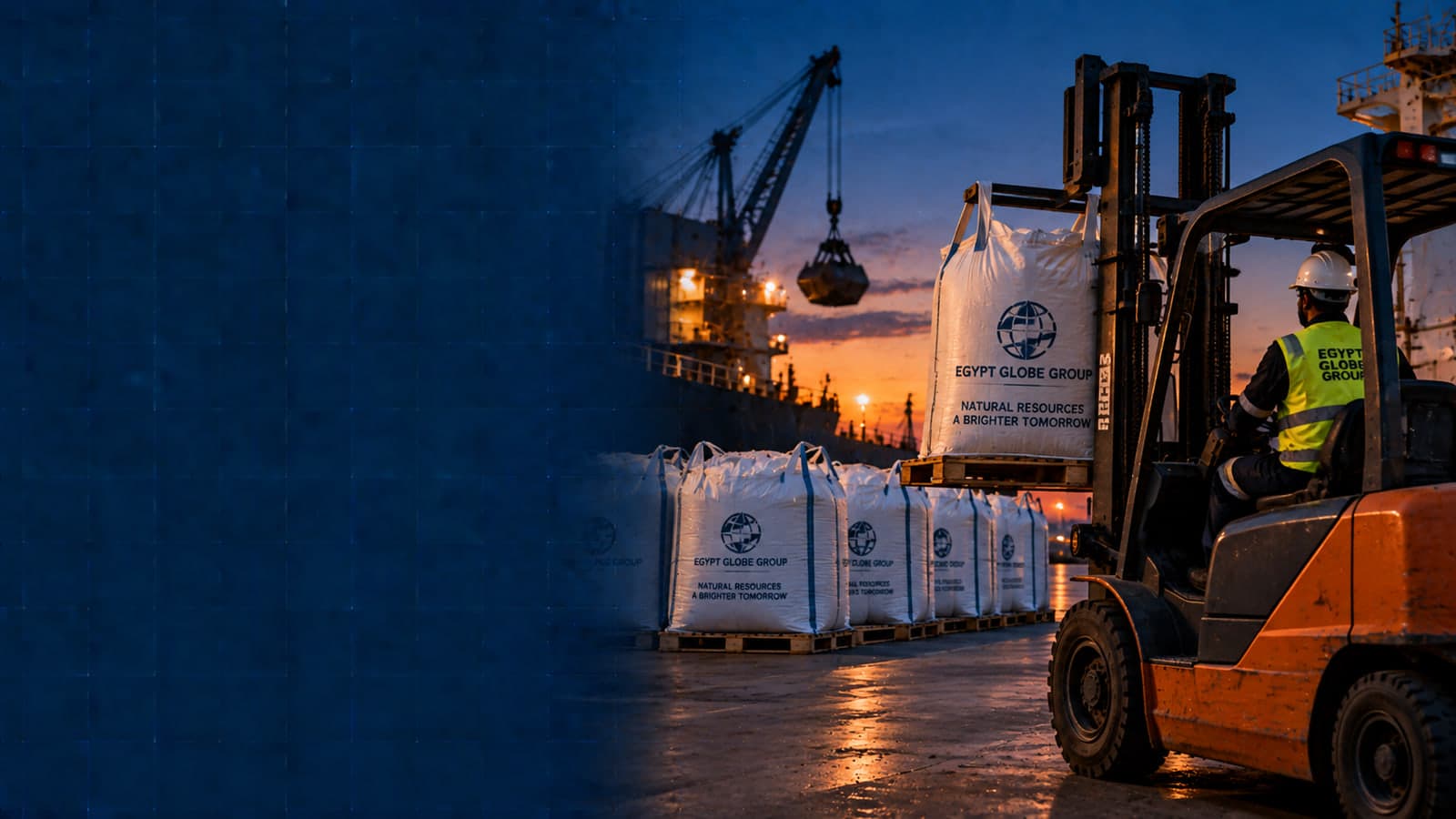
Packing & Containerisation
50 kg PP bags, 1 MT FIBC jumbo bags, containerised loose, palletised, shrink-wrapped — bag types and packing options for every commodity Egypt Globe ships.

Distribution & Warehousing
Bonded warehousing, cross-docking and final-mile distribution from Egyptian ports into MENA, Mediterranean, East Africa and Eastern Europe — buyer-side logistics quoted as a transparent add-on to FOB / CFR / CIF, under the same lot traceability as the loading port.

Inspection & Quality Control
Pre-shipment inspection coordination at all 8 Egyptian export ports — TÜV Austria, SGS, Intertek primary partners (all ILAC + IAF accredited). Cost typically 0.3-0.5% of FOB value, 3-7 day lead time.

Trade Documentation
Full Letter-of-Credit document set — Proforma, Commercial Invoice, Packing List, Bill of Lading, Certificate of Origin (Egyptian Chamber of Commerce), EUR.1 / PAFTA / COMESA / AfCFTA preferential origin, Phytosanitary and per-lot CoA — checked against L/C clauses before presentation.
Frequently asked questions
Which activities does Added-Value Processing include?
What proof is issued for Added-Value Processing?
How is quality controlled under Added-Value Processing?
What standards does Egypt Globe Group work to for Added-Value Processing?
Other questions? Email our export desk — the export desk replies to every request.